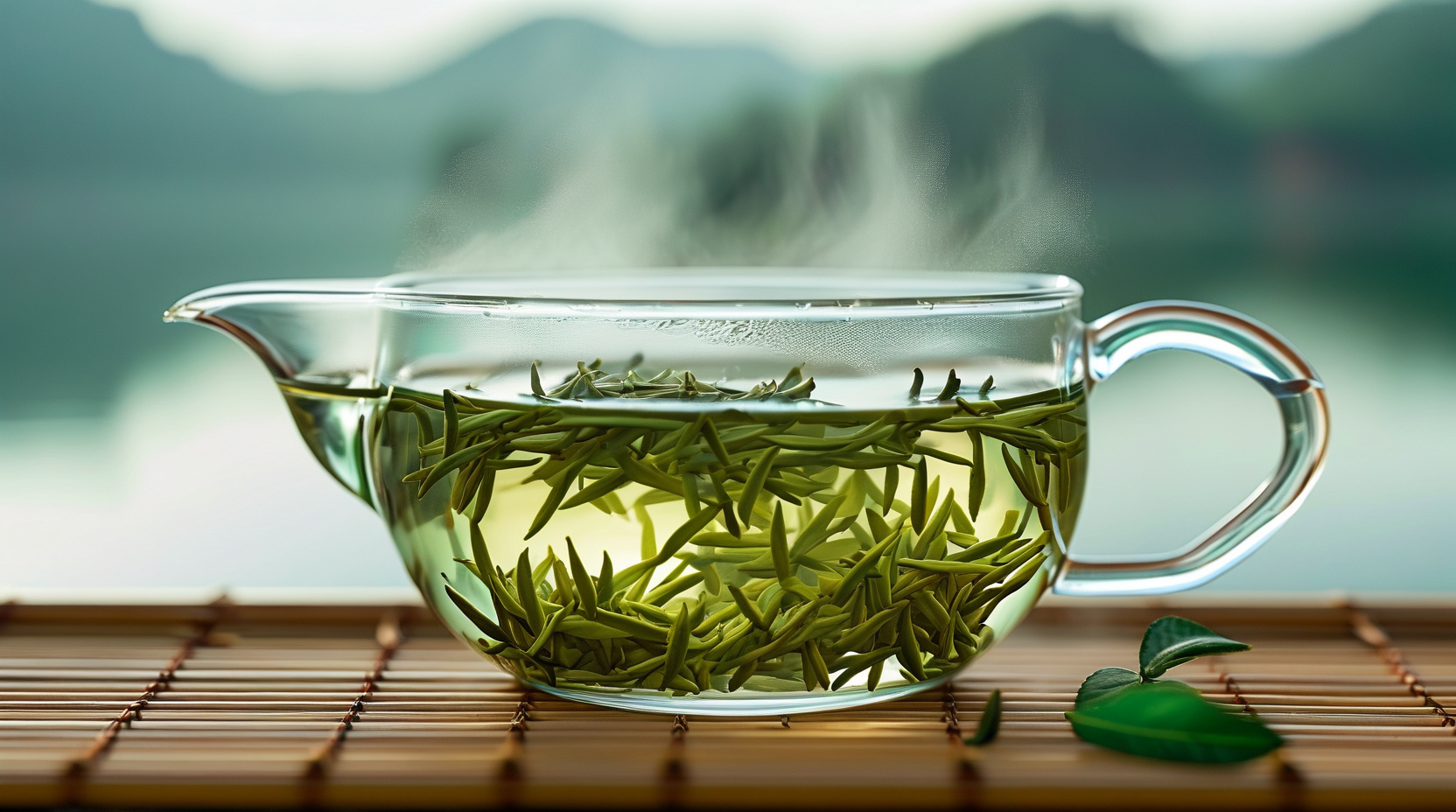
Biluochun, whose name translates literally to “Green Snail Spring,” is one of China’s ten most celebrated teas, yet it remains curiously under-represented on Western tea menus. Grown on the mist-laden hillsides that ring East Taihu Lake in Jiangsu Province, this delicate green tea is prized for its unusually fruity aroma, jade-white downy hairs, and the tight spiral that gives the tea its poetic name. To understand Biluochun is to glimpse the Chinese conviction that geography, history, and human touch can be infused into a single sip.
Historical whispers place the tea’s birth during the late Tang dynasty, when local mountain monks first offered wild leaves to traveling scholars. By the Ming era, the Kangxi Emperor—so the story goes—was served an infusion so fragrant that he asked its name. Told it was “Scary-Fragrant” (Xia Sha Ren Xiang) because its perfume startled palace maids, the emperor diplomatically rechristened it “Green Snail Spring,” referencing the spiral shape and early-spring harvest. Whether apocryphal or not, the tale underscores the tea’s reputation for aroma so intense it seems almost alive.
Strictly speaking, only leaf picked within a fifteen-day window in late March to early April, from a narrow 10-kilometer belt of Dongting Mountain (Dong Shan and Xi Shan islands), qualifies as authentic Biluochun. Two cultivars dominate: the small-leaf “Xiao Ye” variety, which yields the highest grade, and the hardier “Fuding Da Bai” clone introduced in the 1980s to extend acreage. Purists insist that the original Xiao Ye, grown among peach, plum, and loquat trees, absorbs floral volatiles through the porous mountain mist, creating the tea’s signature bouquet.
Crafting Biluochun is a race against time and oxidation. Picking begins before sunrise when surface tension in the leaf is highest; only the unopened bud and the adjacent half-expanded leaf are plucked. Within minutes the harvest is carried in bamboo trays to the village “qing fang,” a modest workshop perfumed by fresh vegetation. Here the leaves are withered for thirty minutes on rush mats, just long enough for grassy notes to soften. The critical step is hand-firing in a wok heated to 180 °C. A master tea maker tosses 250 grams of leaf with rhythmic wrist flips, simultaneously killing green enzymes and shaping the curl. Fingers press the leaves against the wok in a spiral motion lasting precisely six minutes; one second too long and the downy hairs carbonize, one second too short and the leaf retains bitterness. After forming the signature snail, the tea is quickly cooled on zinc screens, then given a second, gentler firing at 80 °C to lock in moisture at 6–7 percent. The entire process from garden to finished tea takes less than four hours, a choreography unchanged for three centuries.
Western drinkers often brew green tea with boiling water and then wonder why it tastes like wet hay. Biluochun demands cooler respect. Use 3 grams of leaf for every 150 ml of water, and drop the temperature to 75 °C. A tall, clear glass is traditional: it allows you to watch the spirals unfurl like miniature fern fronds. First, warm the glass with hot water, discard, then add the dry tea; the residual heat awakens the aroma. Pour the 75 °C water along the glass wall to avoid scorching the down. Steep thirty seconds, then sip. The liquor should be the color of early morning chardonnay—pale, bright, with a faint iridescent ring. Second infusion needs only twenty seconds; third can stretch to forty. Beyond three steeps the leaf surrenders its soul, so compost it and move on.
Tasting Biluochun is a vertical journey. Bring the cup to your nose before drinking: top notes of lychee and white peach appear, underpinned by a cool cucumber lift. On the palate, the first impression is silk—an almost oily texture that slides across the tongue. Next comes a sweet pea freshness, then a mineral snap reminiscent of wet slate. The finish is perhaps the most seductive: a lingering honeysuckle sweetness that reappears minutes later, encouraged by your own exhalation. Professional cuppers look for “three greens”—dry leaf green with white frosting, wet leaf emerald, liquor jade—but also listen: when the cooled leaves are rubbed, they should emit a soft rustle called “qing xiang,” proof that firing was exact.
Storage is where many admirers unwittingly assassinate their tea. Biluochun’s volatile esters are allergic to oxygen, moisture, light, and neighbors like coffee. Divide your purchase into weekly portions, place each inside an aluminized zip bag, squeeze out air, then over-wrap with unscented tissue. Store in a sealed tin at 0–5 °C; the vegetable crisper of a refrigerator works, but only if the tea never meets condensation. Allow the tin to reach room temperature before opening; otherwise water will precipitate on the cold leaf like morning dew on a windshield.
Pairing food with Biluochun is less about cuisine than about texture. Its delicate oils are easily bullied, so avoid chocolate gateaux or curry. Instead, serve with steamed river shrimp touched with ginger, vegetarian spring rolls, or fresh goat cheese. The tea’s amino acids wrap around proteins, magnifying sweetness without adding weight. In Suzhou teahouses, it is traditional to accompany the first infusion with slices of crisp cucumber sprinkled with coarse sugar—a pairing that makes both tea and vegetable taste impossibly alive.
Modern science has begun to decode what poets once praised. Biluochun’s unique aroma profile arises from a ratio of geraniol to linalool above 1.2, a figure rarely seen in other green teas. The downy hairs themselves are unicellular trichomes rich in catechin-gallate complexes, explaining the tea’s high EGCG content—up to 9 percent of dry weight—while maintaining low tannic astringency. Researchers at Nanjing Agricultural University recently discovered that the peach trees interplanted among tea bushes release trans-2-hexenal, a volatile that the tea leaf absorbs and then re-emits during firing, lending credence to the old belief that fruit trees perfume the tea.
Travelers wishing to witness the harvest should arrive in Dong Shan village by mid-March, when the hills are carpeted in wild azaleas and the lake is still veiled in cool vapor. Local farmers welcome visitors for dawn picking sessions; wages are paid in tea, not cash. After picking, follow the leaf to the village square where grandmothers demonstrate hand-firing, their palms calloused yet sensitive as tuning forks. The experience ends with a communal tasting around a carved ginkgo table, the lake glinting below like scattered coins. You leave lighter in pocket but heavier in spirit, carrying a small paper envelope of spirals that still hold the mountain’s morning chill.
To drink Biluochun is to eavesdrop on a conversation between lake mist, fruit blossom, and human devotion. It reminds us that tea is not merely an agricultural product but a cultural performance, renewed each spring when the first bud decides to uncurl. Handle it gently, brew it thoughtfully, and it will repay you with a private season that lingers long after the cup is empty.