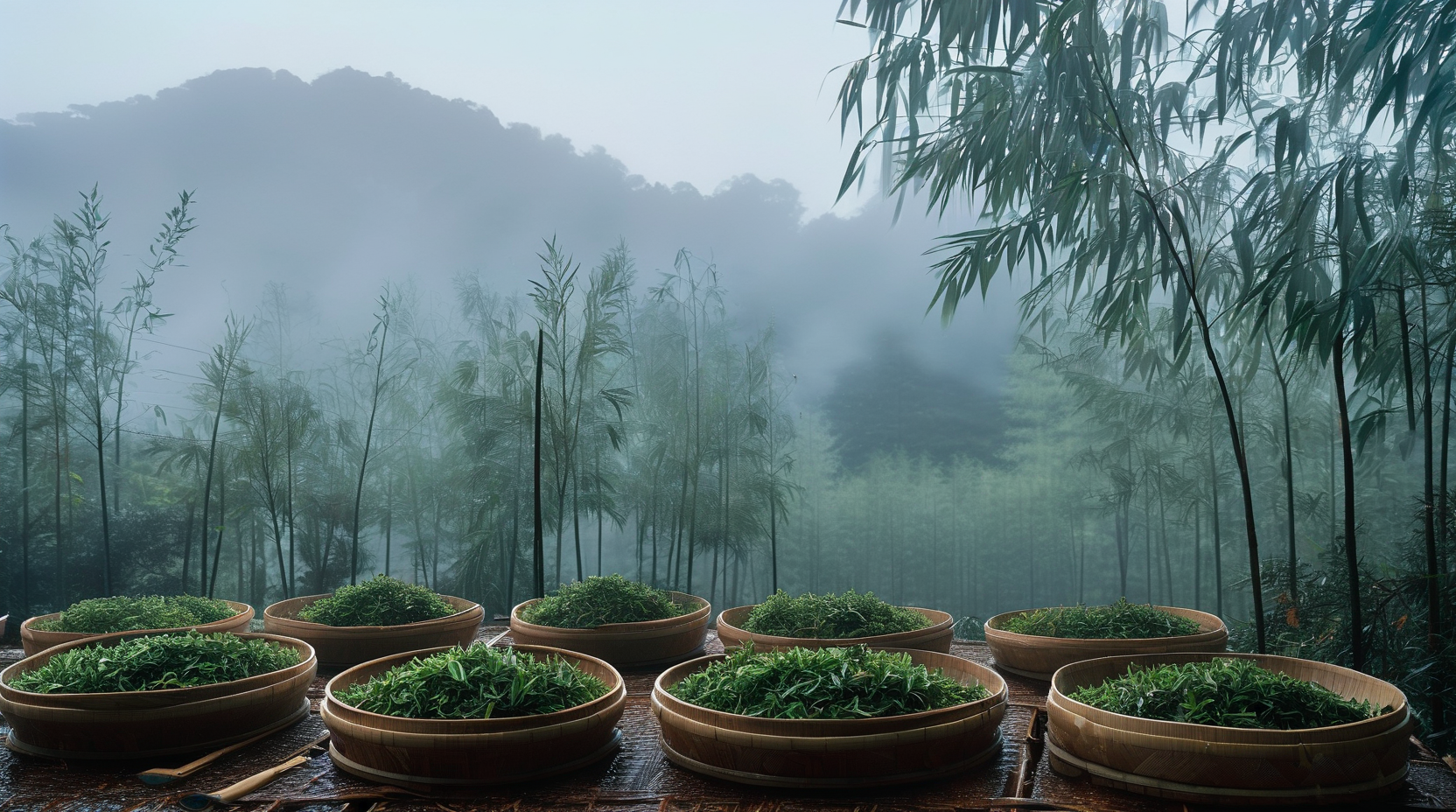
Ask most tea lovers to name a Chinese black tea and the answer is often Keemun or perhaps Dian Hong, yet the very first black tea ever created is still harvested every spring in the rugged Wuyi Mountains of northern Fujian. Locals call it Zheng Shan Xiao Zhong; the West knows it as Lapsang Souchong. Born in the mid-seventeenth century, this leaf carries within its twisted, tar-black strands the story of how China taught the world to drink black tea, and how one accidental night of pine smoke became a signature flavor that launched a thousand ships—literally—toward the docks of London and Amsterdam.
Historical records kept by the Tongmu Guan checkpoint show that prior to 1640 only green and oolong styles were produced in the Wuyi range. The pivot to “hong cha” (red tea, as the Chinese call it) is attributed to an army unit passing through Tongmu village during the Qing dynastic transition. Soldiers commandeered the tea sheds for bedding, forcing farmers to speed-dry their freshly rolled leaves over open pine fires so they could evacuate the crop before sunrise. The resulting liquor—brisk, coppery, and laced with campfire sweetness—was an instant hit with Dutch traders who carried it to Europe as “Bohea,” a corruption of “Wuyi.” By 1669 the British East India Company was listing “Souchon” in its ledgers at prices higher than silver. Thus Lapsang Souchong became the prototype for every black tea that followed, from Assam to Ceylon.
Today the name is legally protected under China’s National Geographic Indication, restricting authentic production to the 600–1,200 m core zone of Tongmu and three adjacent hamlets. Within this 48 km² micro-watershed, the humid subtropical climate, mineral-rich lateritic soil, and constant mist create a natural greenhouse that slows leaf growth and concentrates amino acids. The indigenous cultivar is Xiao Ye Zhong (“small-leaf species”), a semi-wild shrub whose leaves are barely half the size of modern clonal varieties. Locals divide the harvest into three flushes: Ming Qian (before Qingming festival), Yu Qian (before Grain Rain), and spring tail. Only the first two qualify for the highest grade, Wu Shan Zheng Shan, because the buds still contain the winter starch that converts into maltol and vanillin during smoking.
Crafting Lapsang Souchong is a nightly ballet between fire and time. Picking starts at dawn when dew keeps the leaf cells turgid; by noon the baskets arrive at the village’s sole stone courtyard where every family owns a shallow wicker trough called a qing qiao. Here the leaves wither for four to six hours under natural mountain breeze—no machines, no fans. Once the edges turn coral and the grassy note fades, workers roll the leaf by foot-powered bamboo machines that mimic hand-rubbing, rupturing cells to release oxidases. Oxidation itself happens in the cool night air on hemp cloth; the pile is turned every 30 minutes to maintain 24 °C and 85 % humidity. When the leaf reaches a chestnut-brown 80 % oxidation, the master gives the order to song xun—“enter the pine room.”
The pine room is a squat, clay-walled structure whose floor is a maze of brick channels. Down below, pine logs from nearby hills smolder at 70 °C, their resinous smoke wafting upward through adjustable slats. The tea is spread on bamboo mats 1.2 m above the fire for two to three hours, absorbing volatile phenols that will later read as longan, cinnamon, and pipe tobacco. Crucially, the fire is never allowed to flame; smoldering keeps the smoke cool and sweet, preventing the harsh creosote note that marks cheaper, export-grade versions dried over rubber-wood in downstream factories. After smoking, the leaf is briefly re-fired at 90 °C to set the flavor, then hand-sorted to remove stems and golden tips. One kilogram of finished tea requires 4.5 kg of fresh leaf, 6 kg of pine wood, and 18 man-hours.
International markets often encounter two styles: the traditional pine-smoked and the newer “unsmoked” or “fruit-style” Zheng Shan Xiao Zhong favored in Beijing and Shanghai. The latter skips the pine room, finishing the leaf in electric ovens to highlight natural honey and dried-longan notes. Purists argue it is no longer true Lapsang, yet both versions share the same cultivar and terroir, offering a fascinating split personality for comparative tasting.
To unlock the drama in the cup, gongfu brewing is essential. Use a 120 ml porcelain gaiwan or Zhu Ni clay pot pre-warmed with 95 °C water. Measure 5 g of dry leaf—about two heaping teaspoons—and rinse for three seconds to wake the aromas. The first infusion, 10 seconds, yields a brilliant amber liquor with a pronounced pine-top note reminiscent of single-malt Islay whisky. By the third steep, at 20 seconds, the smoke relaxes into longan and dark honey, while the fourth and fifth steeps reveal a cooling camphor finish that lingers on the palate like mint chocolate. Total steeping potential is seven infusions, after which the leaves can be simmered in milk for a smoky chai base. Western-style brewing works in a pinch: 3 g per 250 ml, 96 °C, four minutes, but expect a broader, less nuanced profile.
Professional cupping follows the Chinese “5-factor” score sheet. First examine the dry leaf: high-grade shows glossy black with occasional golden tips and a faint amber translucence along the edge—evidence of skillful smoking. In aroma evaluation, the smoke should be “clean,” free of soot or kerosene taint; a quick shake in a pre-warmed cup should release scents of pine resin, dried apricot, and cacao. Liquor color targets a clear, bright “cognac orange” under white light; any murkiness signals over-smoking. Flavor balance is judged by the ratio of “song xiang” (pine fragrance) to “gan” (returning sweetness); the best lots finish with a cooling sensation at the back of the throat known as “shan qi” or mountain air. Finally, leaf integrity: when opened, the buds should resemble tiny brown moths, intact and elastic, not crumbly or carbonized.
Lapsang Souchong’s culinary versatility has made it a darling of Michelin kitchens. The granulated tea can be cold-smoked over duck breasts, infused into butter for lobster, or ground with Sichuan pepper to crust venison. Pastry chefs prize its natural vanillin for adding depth to dark-chocolate ganache without extra sugar. Meanwhile, mixologists steep it in mezcal to create a “Wuyi Old-Fashioned,” garnished with a flamed orange peel that echoes the original pine fire.
Health research from Fujian Agriculture University shows that the unique combination of guaiacol and syringol—two phenolics born of pine smoke—exhibits stronger antioxidant activity than EGCG in green tea when tested on human dermal fibroblasts. However, the same study cautions that heavy smoking can raise PAH levels; hence the push toward lighter, “clean smoke” protocols in Tongmu. For consumers, the takeaway is moderation: two to three gongfu sessions per week offer polyphenol benefits without overexposure.
As climate change warms the Wuyi micro-zone, harvest is creeping earlier each decade. The village cooperative has responded by planting shade trees and reviving heirloom clones with deeper root systems. A new generation of tea masters, many of them women who learned cupping via TikTok livestreams, is experimenting with cherry-wood and bamboo-leaf smoke to create softer profiles for entry-level drinkers. Yet the soul of Lapsang Souchong remains unchanged: a leaf that carries the scent of pine and mountain mist across four centuries, reminding every sipper that black tea began not in Assam’s plains but on a foggy Chinese cliff where fire met leaf and history exhaled.