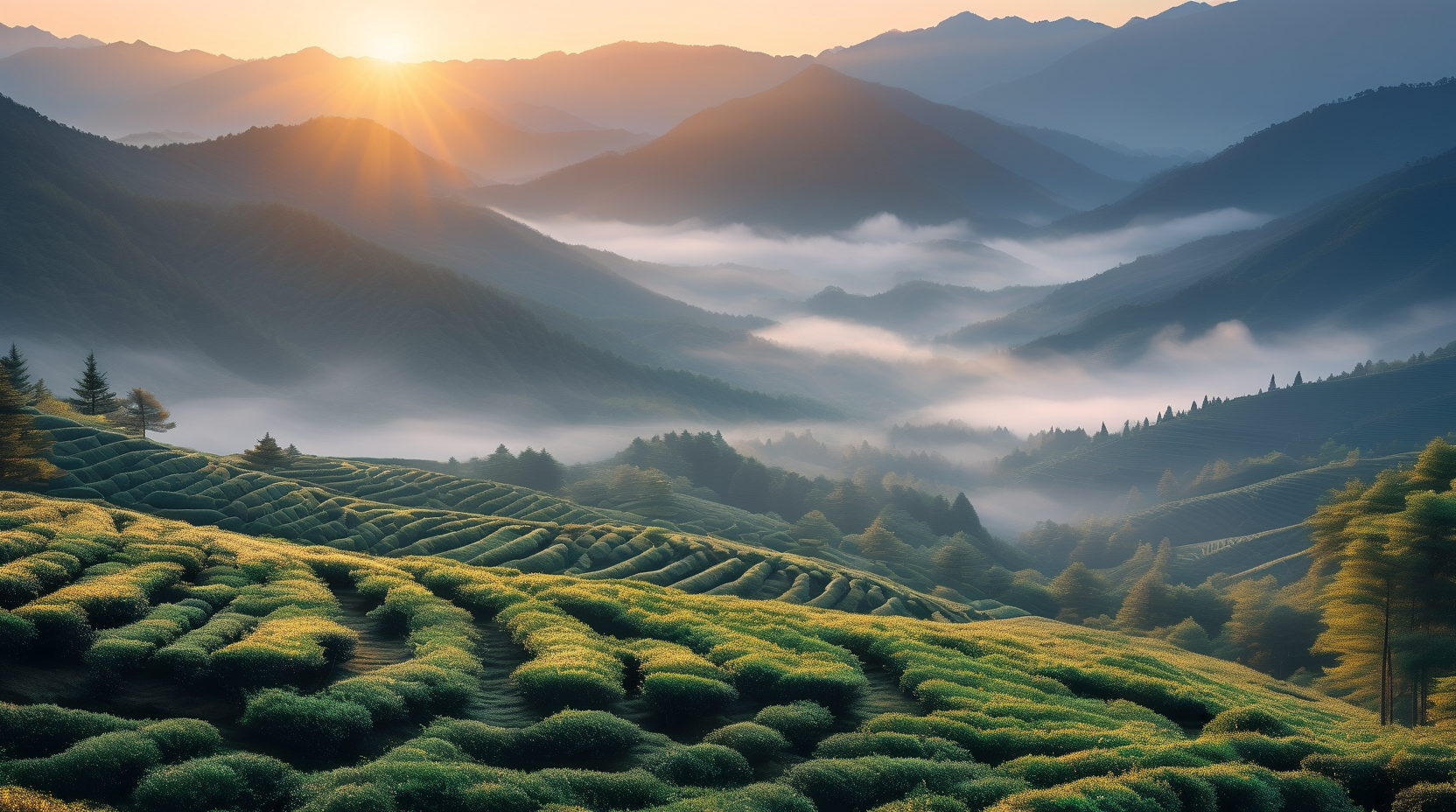
Tucked high above the Sichuan basin, where perpetual cloud veils the Min River gorge, lies Meng Ding Mountain, the cradle of the world’s oldest cultivated tea garden. It was here, in the mist-crowned terraces of Ya’an, that Buddhist monks first coaxed the down-covered buds of Camellia sinensis into a liquor so luminous and fragrant that Tang-dynasty emperors decreed it gong cha—“tribute tea”—and forbade commoners from tasting it. The variety they guarded was Meng Ding Huang Ya, the golden bud of Meng Ding, a yellow tea so elusive that even seasoned Chinese connoisseurs today speak of it in the hushed tones reserved for legend.
Although yellow tea as a class shares ancestry with green tea, its destiny diverges the moment the leaf is plucked. Where green tea rushes to lock in freshness with immediate high heat, yellow tea begins a slow, deliberate surrender to time and microbe. The result is a flavor that occupies the liminal hour between night and dawn: greener than oolong, mellower than green, yet brighter than white tea, carrying a whisper of roasted chestnut, steamed corn milk, and the cool stone scent of a mountain temple after rain.
History: From Altar of Heaven to Vanishing Act
Meng Ding Huang Ya’s recorded pedigree begins in 808 CE, when the monk Gan Pu presented it to Emperor Xianzong as an offering for the Altar of Heaven ceremony. For the next nine centuries the tea was levied as tax in kind; caravans of porters carried compressed cakes of it along the Tea-Horse Road to Tibet, where it was exchanged for warhorses. When the Ming court abolished compressed tribute tea in 1391, insisting on loose leaf, Meng Ding Huang Ya survived by adapting its craft to the new fashion. Yet the very intricacy that delighted emperors—its secretive “sealed yellowing” step—became its vulnerability. By the 1950s only a handful of families in Shangli, Ya’an, still possessed the oral formula. When market demand swung toward mass-produced green tea, the variety slipped into near extinction. A 2004 government census listed fewer than 30 mu (two hectares) of authentic bushes. Today, protected by a geographical indication since 2012, the tea is clawing back acreage, but annual yield remains under 1.5 tonnes—rarer than silver-tipped Darjeeling first flush.
Micro-terroir: Where Clouds Press Against Tea
Meng Ding Mountain is not tall—its highest peak, Shangqing, rises only 1 456 m—but it is perpetually humid. Warm, moisture-laden air from the Sichuan basin collides with cold Himalayan fronts, generating 230 fog-bound days a year. The diffused light slows photosynthesis, forcing the bush to synthesize more theanine and fewer bitter catechins. Soils are acidic purple sandstones rich in iron and selenium, flushed by mineral springs that once fed the ancient “Meng Spring” well, whose water Tang scholars declared ideal for brewing its own leaf. The indigenous cultivar is a medium-leaf landrace locally called “xiao ye zhong,” small-leaf stock, whose buds are arrowhead-shaped and cloaked in such dense pubescence that they shimmer like moth wings.
Plucking: One Bud, One Standard, One Hour
The harvest window opens for barely ten days around Qingming (early April). Pickers climb the terraces before 7 a.m., while dew still weighs down the mossy slate paths. Only the “flag-and-one-leaf” shoot is taken: the unopened bud, no longer than 2.5 cm, clasped by a single semi-splayed leaf resembling a miniature banner. The pluck must reach the village workshop within one hour; any delay and the enzymatic profile drifts, jeopardizing the precise choreography of yellowing.
Craft: The Art of Letting It Almost Spoil
-
Sha Qing – “Kill-Green” with Bamboo
The leaves are tumbled for 90 seconds in a wok heated to 160 °C, but unlike green tea the motion is gentle, more caress than slap. A bundle of fresh bamboo leaves is often laid on the iron to impart a grassy perfume and buffer direct heat. Moisture drops to 55 %. -
Men Huang – Sealed Yellowing
While still warm, the leaf is piled 8 cm deep inside oak boxes lined with wet linen. The lid is sealed and the box slid into a cave-like chamber kept at 28 °C and 75 % humidity for 48–72 hours. During this covert interval chlorophyll quietly degrades, polyphenols oxidize just enough to shed astringency, and a golden pigment—xanthophyll—rises to the surface. The tea master cracks the lid every six hours to inhale; the scent must move from steamed rice to dried apricot to orchid without ever tipping toward sour. It is a dialogue with decay stopped at the brink. -
Mao Huo – Low Bamboo Fire
The now-yellow leaf is dried in three passes over a charcoal pan made from local cedar ash. Temperature never exceeds 60 °C; hands shuffle the leaf through a bamboo screen the size of a tambourine. The goal is to coax remaining moisture down to 7 % while embedding a toasted nut note. Between passes the leaf rests, allowing internal moisture to migrate outward—an echo of yellowing that continues even as water leaves. -
Selection & Resting
Only 60 % of the original batch survives; discolored or broken leaves are sifted out. The finished tea is wrapped in handmade rice paper and left to “sleep” for 30 days in a cedar cabinet so the flavor can knit together. When finally released, the dry leaf resembles slim golden needles, each bristling with down and releasing a scent of roasted sweet corn kissed by mountain orchid.
Brewing: A Ritual of Gentle Heat
Water: spring water at 85 °C; hard water flattens the velvety texture.
Leaf: 3 g for a 150 ml gaiwan or 4 g for a 200 ml glass pot.
Rinse: none; the first kiss of water is your opening note.
Infusions:
- 30 s: pale champagne liquor, aroma of fresh lilies and warm brioche.
- 25 s: deeper yellow, flavor expands into custard apple and a cooling menthol finish.
- 35 s: honeyed notes emerge, texture becomes silkier, throat returns a lingering “mountain spring” sweetness.
- 50 s: lighter but still aromatic, a whisper of almond milk.
Stop at the fifth infusion; the leaf has given its quiet autobiography.
Glass-pot Method for Beginners:
Place 2 g of leaf in a tall glass, fill one-third with 80 °C water, swirl for ten seconds, then top up. Watch the needles drift like gold filaments before they stand upright—a scene locals call “golden bamboo shoots after rain.”
Tasting: Listening to the Third Note
Professional cuppers evaluate Meng Ding Huang Ya by the “three breaths” method. First breath, inhale the dry leaf: you should detect corn silk plus a trace of iron, reminiscent of mountain spring water. Second breath, after the first infusion, smell the underside of the gaiwan lid; a high-quality lot will present what elders call “gui hua qing”—a ghost osmanthus note that arrives only when yellowing has been perfectly timed. Third breath, hold the liquor on the back of the tongue and breathe through the nose; a cooling sensation in the sinus, like walking into a stone grotto, signals abundant theanine and indicates the tea was plucked before Qingming.
The finish should be clean, leaving the palate thirsty for more water—a paradox known as “sheng jin,” fluid production. If you detect baked bean or spinach, the kill-green was too hot; if sour plum, the yellowing overstayed.
Storage: Let It Breathe, But Not Too Much
Unlike pu-erh, Meng Ding Huang Ya does not improve with age. Keep it in an unglazed clay jar nested inside a paper box, away from light, odors, and moisture. Aim for 50 % relative humidity and a stable 20 °C. Under these conditions the tea retains its peak aroma for 18 months; after that it fades into a pleasant but muted hay sweetness.
Pairing: Food That Steps Aside
Serve it with subtle foods: steamed river fish with ginger, fresh tofu dressed with light soy, or water chestnut cake. Its low astringency makes it forgiving with delicate textures, yet the lingering sweetness can cleanse the palate after buttery pastries. Avoid citrus, chili, or blue cheese—their volatility bullies the tea’s whispered complexity.
Modern Echoes: From Monastery to Mixology
In Chengdu’s speakeasy bars, avant-garde bartenders now fat-wash gin with Meng Ding Huang Ya, then shake it with local honey and Sichuan pepper for a cocktail called “Mist of Shangli.” The tea’s natural creaminess replaces dairy, creating a vegan foam that carries the pepper’s buzz without the burn. Meanwhile, skincare startups extract its xanthophyll for antioxidant serums marketed as “yellow gold for the face.” Yet the monks of Meng Ding still offer the first picking to the stone Buddha at Gan Pu’s original temple, maintaining a lineage unbroken since the ninth century.
Sustainability: Guarding the Fog
Climate change threatens the very clouds that cradle the mountain. Over the past four decades fog days have decreased by 15 %, pushing growers upslope. A cooperative of 42 families has responded by reviving traditional shade trees—ginkgo, camphor, and magnolia—interplanted among tea bushes to recreate artificial mist and stabilize humidity. Their efforts have restored 8 % of lost fog retention and provided habitat for the endangered Sichuan partridge. Each kilogram of Meng Ding Huang Ya now carries a QR code linking to blockchain records of pluck date, yellowing chamber conditions, and carbon footprint, assuring global drinkers that rarity need not come at ecological cost.
In every sip of Meng Ding Huang Ya one tastes the tension between preservation and transience: a tea that must almost spoil to become perfect, that survives only when watched second by second, that gifts the drinker a morning of Tang-dynasty mist condensed into a golden drop. It is, perhaps, the closest liquid form of time travel we possess.