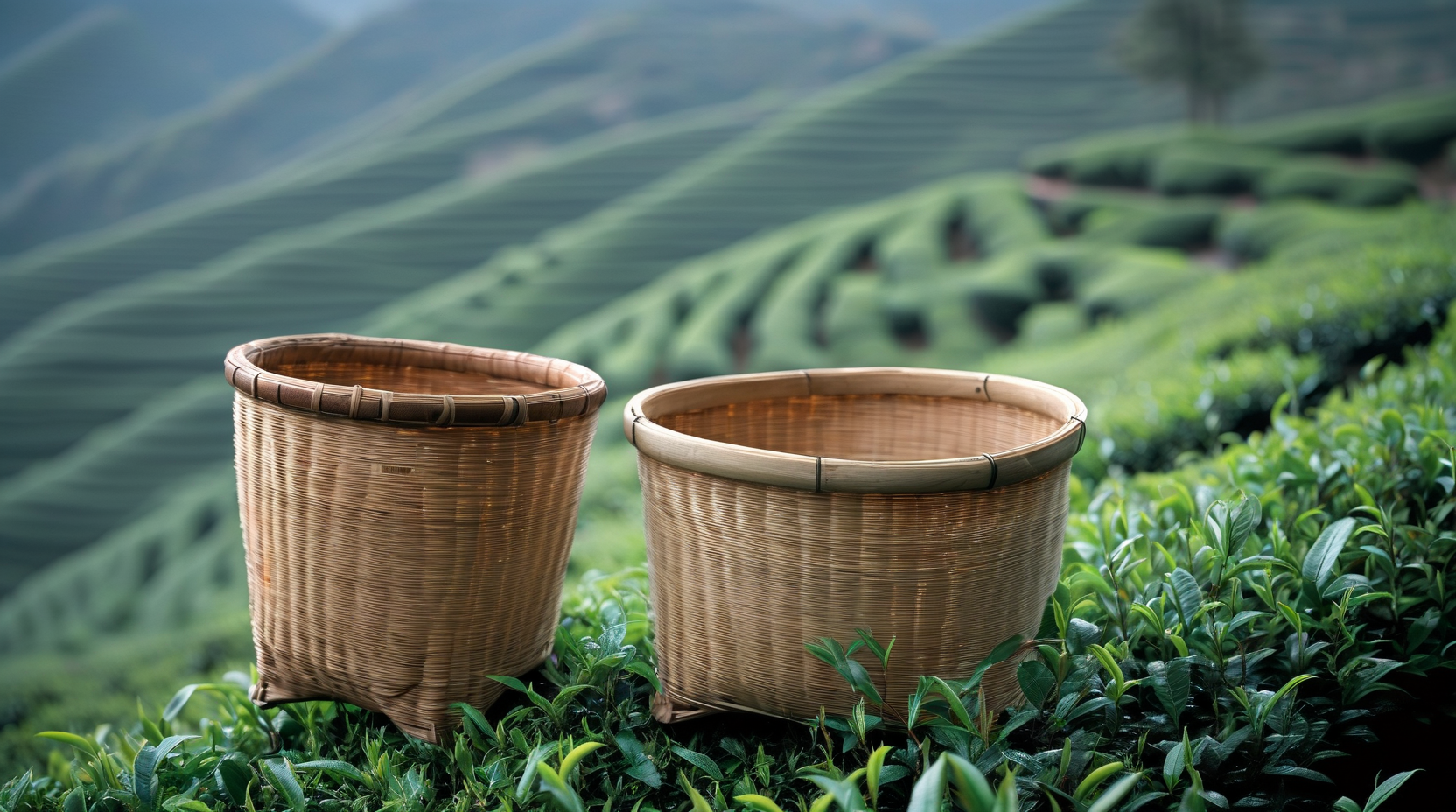
Tucked high above the Sichuan basin, where perpetual cloud veils the Min River gorge, lies Meng Ding Mountain, the cradle of the world’s oldest cultivated tea garden. It was here, in the mist-cooled terraces of Ganlu Temple, that Buddhist monks first coaxed the down-covered buds of Camellia sinensis into a liquor so luminous that Tang-dynasty emperors decreed it “tribute of the first spring.” Today that same bud, still pluned by hand for only ten frost-free days each April, is known as Meng Ding Huang Ya—Meng Ding Yellow Bud—the most discreet yet regal member of China’s endangered yellow tea family.
Unlike green tea’s brisk immediacy or pu-erh’s decades-long metamorphosis, yellow tea occupies a vanishing middle ground: it is deliberately stalled on the edge of oxidation, persuaded to “smile” for seventy-two secret hours while retaining the freshness of spring. Of the three surviving yellow styles—Jun Shan Yin Zhen of Hunan, Huo Shan Huang Ya of Anhui, and Meng Ding Huang Ya—Meng Ding is the smallest, the earliest harvested, and the only one never fully mechanized. Each kilo demands 42,000 buds, plucked at dawn when two leaves sheathe a spindle-shaped tip no longer than a sparrow’s tongue. Once you see those buds, pale jade on the tree, you understand why Song poets called them “the moon’s teeth.”
History whispers through every terrace. In 724 CE the monk Wu Lizhen transplanted wild tea onto the summit, establishing the first state-sponsored plantation. By Song times the court mandated that Meng Ding tea ride the post-horse relay 2,100 km to Kaifeng within thirteen days, a feat celebrated on scrolls now kept in the Palace Museum. When the Ming emperor abolished compressed tea in 1391, the mountain switched to loose leaf, but kept its yellowing craft alive inside monastery walls. During the twentieth century wars and collectivization nearly erased the technique; only a handful of families in Shangqing township remembered the exact choreography of wrapping, sweating, and re-firing. In 2008 UNESCO listed the knowledge as “intangible cultural heritage in urgent need of safeguarding,” and today fewer than eighty artisans are licensed to produce authentic Meng Ding Huang Ya.
The cultivar itself is a local landrace, Xiao-ye zhong, “small-leaf lineage,” evolved to thrive at 1,400 m beneath a 96 % relative humidity cloak. Its leaves are unusually rich in theanine (3.8 %) and low in catechins (12 %), a ratio that gifts the tea its signature umami-sweet broth without the grassy bite common to early-spring greens. Because the mountain blocks morning sun, buds grow slowly, stacking amino acids like crystal layers; one night of mountain dew can add a full milligram of soluble sugar per leaf.
Processing begins the instant baskets descend to the village courtyard. The first kill-green is a 90-second tumble in a 160 °C wok, just enough to rupture peripheral cells and anchor the green hue. While leaves are still warm they are wrapped in steamed cotton cloths the size of pillowcases; this “men huang,” or sealed yellowing, is the heartbeat of yellow tea. Bundles rest in a pine-wood cabinet at 28 °C and 75 % humidity for three hours, then are opened, fanned, and re-wrapped up to seven cycles across three days. Between wraps the leaves are hand-rolled into feather-shaped strips, coaxing stem moisture toward the tip so chlorophyll can quietly transmute into pheophytin, the pigment that paints the liquor sunflower-gold. A final charcoal bake at 55 °C for forty minutes lowers moisture to 5 %, locking in a cocoa-butter aroma that will later bloom in the cup.
The finished tea is visually modest: slim, matte, the color of wheat straw, with a faint down that smells like rain on hot limestone. Yet the moment hot water lands, the bud re-animates, standing upright like a glass forest before drifting horizontally in slow motion. Western drinkers often mistake this dance for the “agony of the leaf” in oolong, but here it is subtler, a languid unfurl earned during yellowing.
To brew Meng Ding Huang Ya authentically, one must respect its dual nature: sturdy enough for imperial courier, yet fragile in the teapot. Begin with mountain spring water whose TDS lies between 30–80 ppm; high mineral content dulls the orchid note. Heat to 85 °C—just when bubbles pearl the kettle bottom like a string of jade beads. Use a tall, thin-walled glass or a 120 ml porcelain gaiwan; transparency allows you to witness the color shift from crocus to old gold in thirty seconds. A 1:50 leaf-to-water ratio (3 g to 150 ml) is ideal. After rinsing the buds with 50 ml of water for three seconds to awaken them, steep the first infusion for forty-five seconds, subsequent infusions adding ten. Four infusions reveal a complete arc: dewy pea shoot, then steamed corn milk, finally toasted hazelnut and a lingering coolness that the Chinese call “mountain rhyme.”
Professional cupping follows a quieter ritual. Five grams are placed in a 110 ml white porcelain tasting set, water at 90 °C, three minutes undisturbed. The liquor should read “bright yellow-green” on the SCAA chroma chart, transparency above 95 %. Aroma is evaluated in three temperature windows: hot (85 °C) for vegetal top notes; warm (45 °C) for floral honey; cool (25 °C) for mineral finish. Slurping aerates the tea across the palate; a qualified taster looks for “sweet aftertaste at the back of the throat arriving within eight seconds” and “absence of astringency on the lateral tongue.” A tell-tale sign of genuine Meng Ding Huang Ya is a faint cooling sensation in the lower jaw, attributed to the amino acid theanine binding to T1R3 sweet receptors.
Storage is the final guardian of heritage. Because yellow tea retains 1–2 % residual enzyme activity, it breathes slower than green yet faster than white. Vacuum sealing at 4 °C extends peak flavor for thirty months; however, connoisseurs often cellar small lots at 20 °C and 60 % humidity, enjoying the gentle oxidation that, over five years, turns the liquor amber and adds notes of dried persimmon. Unlike pu-erh, yellow tea does not improve indefinitely; after eight years the bouquet collapses into flat cereal.
Modern science is now decoding what monks once guarded. A 2022 study at Sichuan Agricultural University found that the yellowing step creates a unique metabolite, 5-methoxy-indole-3-acetic acid, that up-regulates GABA receptors in mice, inducing measurable anxiolytic effects within thirty minutes of ingestion. Another paper identified a rare flavonol glycoside, mengdingoside, that inhibits α-glucosidase at low micromolar levels, hinting at anti-glycemic potential. Yet the tea’s greatest value may be cultural: it is a living manuscript of Chinese restraint, a beverage that asks the drinker to pause, observe, and taste the interval between green and black.
For the international enthusiast, sourcing authentic Meng Ding Huang Ya requires vigilance. Look for harvest dates between March 25 and April 5, a lot number traceable to Shangqing township, and a certificate from the Meng Ding Mountain Tea Research Institute. Price will never be trivial: 100 g of first-grade buds retails above USD 180, reflecting both scarcity and the three-day handcraft. Yet when you finally pour that sunflower-gold liquor and feel the mountain mist condense across your tongue, you will understand why the Tang emperor once proclaimed, “This tea is the quietest conversation between heaven and earth.”